Maslow’s Hierarchy and Bloom’s Taxonomy

Maslow’s Hierarchy of need starts with self-actualization then dependents to esteem and so on to love and belonging, safety needs, and physiological needs. The needs at the end of the phyrimid must be satisfied before someone can worry about needs listed higher. The first four needs are deficiency needs and the last need is a growth need. Deficiency needs motivate people to fulfill them, the longer they are not satisfied the more it motivates people to satisfy them. Needs do not need to be completely satisfied to worry about needs in higher rating. Deficiency needs are motivated by the lack of something while growth needs are motivated by the desire to grow. Every person has the desire to move up to self-actualization but often people don’t reach this level due to the fact they can’t move past the lower levels. 

The first stage os physiological needs which is requirements for survival. Which consistent of what the body needs to function optimally. The second stage is safety needs. This includes things like security and law. The third stage is love and belongingness which is social. These are interpersonal relationships people have such as friendship and intimacy. Things like being in a group including a family or even work. The forth stage is esteem. This is broken into two categorizes; esteem of oneself and respect from others. Finally the fifth stage is self-actualization. This is when someone realizes their potential. These needs are organized in a hierarchy, however, the hierarchy is flexible. 

The hierarchy has been expanded over time. Now, cognitive, aesthetic, and transcendence needs are included. Forming a new model that goes  biological physiological needs, safety needs, love and belongings needs, esteem needs, cognitive needs, aesthetic needs, self-actualization, and finally transcendence needs.

Self-actualization is the fulfillment through growth; this is the realization of what is important to a particular person, their meaning of life. This is a continues process. Only 2% of people reach this point. There are 15 characteristics that are found in people who reach self-actualization. They are they perceive reality efficently, accept themselves and others for what they are, they are spontaneous, problem-centered, unusual sense of humor, look at life objectively, creative, resistant to enculturation, concurred for the welfare of humanity, capable of deep appreciation of basic life-experience, establish deep interpersonal relationships, peak experiences, need privacy, democratic attitudes, and strong morals. 

Maslow hierarchy is important to implement in the classroom because it explains how before cognitive needs can be met, physiological needs must be met. Low self-esteem will hold children back in the classroom so teachers must create a supportive environment.

Bloom’s Taxonomy of learning domains goes from creating at the top to evaluating, analyzing, applying, understanding, and at the bottom remembering. This promotes higher forms of thinking. It is used to design educational training and learning processes.

There are three domains of learning cognitive, affective, and psychomotor. These are the goals of the learning process meaning after a lesson a students should acquire new skills, knowledge, and attitude. 

The cognitive domain focuses on knowledge and intellectual skills. There are six major categories knowledge, comprehension, application, analysis, synthesis, and evaluation. 

This was later revised by changing the names of the six categories, rearrangement of the categorizes, and creating a processes and level of knowledge matrix. The new domain goes from creating, evaluating, analyzing, applying, understanding, and finally remembering. This is an active form of thinking. The matrix includes three levels of knowledge factual, conceptual, procedural. There is also another level of knowledge known as metacognitive. 
Annotation #3

Source reference

Stege, L., Lankveld, G., & Spronck, P. (2011). Teaching High School Physics with a Serious Game. International Journal of Computer Science in Sport, 10(1), 1-12.

Article type

Experiment

First citation

The video game E and Eve’s electrical Endeavors was developed by Eindhoven University of Technology to develop skills and acquire knowledge about electrical engineering (Stege et al., 2011).

Summary 

An experiment was conducted to see if serious games or if traditional text are more effective. In the study done effectiveness in answering questions and motivational effect are both being examined. In conclusion males acquired more knowledge through video games. Females showed no difference in text or video games. however, electrical engineering is not often a subject of interests for woman. 

In-depth summary

Entertainment games are used for pleasure while educational games are used to develop skills and knowledge. Serious games are games that have the purpose of educational games but look like entertainment games. When researching educational games it is seen that playing games motivates children which leads to better results. Educational games knowledge is clearly stated while in serious games knowledge is taught through game mechanics. In this article the serious game of E and Eve’s Electrical Endeavors was used to teach high school students electrical engineering. This game was compared to a high school textbook on its’ ability to teach students about transistors. In the study done effectiveness in answering questions and motivational effect are both being examined. 

Serious games are faced with the issue of being not educational enough or not entertaining enough. Video games have been making their way into the classroom more and more. Studies done on video games in the classroom have shown that realism in video games has a positive influence on knowledge gain. It is also seen that games develop collaboration skills. The reason why their is so much hope behind serious games is it is believed that games will motivate children. Traditional schooling methods do not motivate children. Engaging students is needed to make them active learners. However, games might not be the best medium.

The experimental setup done divided high-school students into two groups; one group used a video game to learn transistors while the other group used the traditional method through text to learn transistors. The effectiveness of being able to answer the same questions on the materials was later tested, and so was the student’s motivation.

The video game E and Eve’s electrical Endeavors was developed by Eindhoven University of Technology to develop skills and acquire knowledge about electrical engineering. To complete the game players must move wires to escape. While moving the wires, players have to deal with issues involving resistance, transistors, and power shares. The students who played the game only completed two of the ten chapters involved with the game; allowing them to learn the instructions in chapter one and complete the level about transistors in chapter two.

187 students were used in the experiment. 47% of the students were male and 53% of the students were female, 7 participants did not indicate their gender. The average age of the students were 15. In the game group there were 48 male participants, 44 female, and 5 participants who did not report their gender. In the text group there were 37 male participants, 51 female, and 2 participants who did not report their gender.

Through this experiment it was discovered that the game group had significantly more successfully answers than the text group. However, students playing the video game reported being less motivated than the students who used the text. When examined closer it was concluded that text better motivates females; Games and text have no difference in motivation for males. realizing gender playing a role in the results, gender was examined further. Male students stereotypically do better in physics than females. When comparing male students only on their scores it was seen that video games made a big significance in score change. For female students, the game had no benefit. Despite females not benefiting from the games and the game group not reporting higher motivation 78.8% of students reporting wanting serious games to make their way into the classroom.

While reporting from students stated that video games were not motivational, surveyors expressed that the kids playing the video games got right to work while the kids required to read text were not motivated at all. The text group had more complaints and asked more questions. Students were randomly placed in groups but most students stated they would rather play the game.

In conclusion males acquired more knowledge through video games. Females showed no difference in text or video games. however, electrical engineering is not often a subject of interests for woman. 

Evaluation (strengths and weaknesses)

Strengths: Gender was looked at closely and variables that could cause difference in gender results made sense.

Weaknesses: There were three weakness in the experiment as a hole making the conclusion about serious games not a firm conclusion instead a hint for future research. The weaknesses were there was no pre-test of prior knowledge, there was no control group, and collaboration was allowed. 

Relation to my research question

This article relates to my topic because it is an example of traditional teaching being compared to serious games and its effectiveness for students. It also showed promising results which helps my report. 

Significant quotes

However, serious games can be distinguished from educational games in that they are designed to look more like commercial video games than their counterparts (Stege et al., 2011, pg. 1)

In general, in educational games knowledge is represented explicitly, while in serious games knowledge is represented implicitly in the game mechanics (Stege et al., 2011, pgs. 1-2)

The game we used is called E and Eve’s Electrical Endeavors. It is an online serious game, that was developed by the Eindhoven University of Technology. The purpose of the game is helping players to develop skills and acquire general knowledge about electrical engineering (Stege et al., 2011, pg. 3)

We may cautiously conclude, however, that serious games (at least the one we used in our research) have the potential to be more effective in education than textbooks, in particular for male students (Stege et al., 2011, pg. 9)

Annotation #5

Source reference

Haynes, K. 12 easy Ways to Use Technology in the Classroom, Even for Technophobic Teachers. Teachhub.

https://www.teachhub.com/12-easy-ways-use-technology-your-classroom-even-technophobic-teachers

Article type

Online Newspaper Article

First citation

There are so many webquests on the Ineternet (Haynes, K., par.9)

Summary

There are numerous ways technology can be used in the classroom. It can be scary trying out new games however, there are numerous resources that make using games in the classroom easy and effective.

In-depth summary

Technology in the classroom is a new trend people want teachers to jump on. However, teachers are very busy and sometimes don’t like the idea of the use of technology in the classroom. This article shows how easy it is to use technology in the classroom. There are a couple questions about accessibility teachers need to ask to get started.

Powerpoint can be used to reenact game shows. This can be used for review. Templates are all over the internet allowing teachers to remake “Jeopardy,” “The Weakest Link” and “Who Wants to Be a Millionaire.”

Teachers can ask students to complete written assignments online. They can write dairies from perspectives of different people. Creating blogs or twitting is another way to have students summarize lessons. Webquest guide research.

Technology can not only be used in the classroom it can also be the topic for assignments. Students can explain and make tutorials of how to use technology they frequently use, such as video games.

Besides class technology is beneficial to teachers. Class announcements can be made on a class webpage. Not only can announcements be posted, class photos and materials can be on the page. Grading is also frequently done online. This allows the tracking of grades, recording of attendance, and so much more.

Evaluation (strengths and weaknesses)

Strengths: The ideas were broken down in a way that made them feel simple and easy to use in the classroom but also showed how they can make learning fun.

Weaknesses: The article had many ideas but the ideas were only good for older children such as high school age. Middle school could also use some of the ideas given.

Relation to my research question

Talking about different games used in the classroom and other ways technology is used to make teaching easy.

Significant quotes

A webquest guides students to search the Internet for specific information (Haynes, K., par. 9).

It’s a natural fit, as young people usually have a higher comfort level with technology than many adults (Haynes, K., par. 11).

offer the opportunity to track grades, record attendance and seating charts, and compile reports on student progress (Haynes, K., par. 13)

Annotation #2

Source reference

Janarthanan, V. (2012, April 16-18). Serious Video Games: Games for Education and Health. Ninth International Conference on Information Technology – New Generations, 

https://ieeexplore.ieee.org/abstract/document/6209109/metrics#metrics

Article type

Scholarly article

First citation

Children playing Monopoly and Sudoko increase their analytical skills, ability to handle different situations that are stressful for make them panic, as well as, have good public relation skills (Janarthanan, V., 2012, par. 3).

Summary

            Serious video games are games targeted for education, including science, research, training, etc. These types of games form an educational environment. The different skills formed through the play of these games lead to a more successful student. Different strengths can be gathered though games played in primary, high school, college, and universities.

In-depth summary

            Video games are making their way to the classroom, shaping learning techniques used by students. Games are being played in primary, high school, college, and universities. These games increase how fast students are picking up topics. In universities and colleges video games are being used to train students in their field. Through video games students perfect their technique to play better which can be used as an asset in the real world.

            Children playing Monopoly and Sudoko increase their analytical skills, ability to handle different situations that are stressful for make them panic, as well as, have good public relation skills. Video game players also easily identify items in visual environments. In a study done comparing gamers verses non-gamers, the gamers were able to process visual information faster and track 30 percent more objects.

            Problem solving is linked to fluid intelligence. Being able to manage multiple objects or resources allows people to become smarter. In video games, when learning the rules and strategies you are building those skills. Video gamers also hypothesis constituently; games are goal driven so gamers must keep redoing their actions differently to progress in the game.

            Their is an increasing amount of depressed children in today’s society. Video games can improve depression by building self esteem. As a student makes accomplishments in the game they progress. This makes students feel good about themselves. Games can also help emphasize with the opposite sex. Games normally allow players to pick a gender, stereotypically players pick their own gender some pick the opposite gender. Most games target boys, however, there is a growing increase in girl gamers. In 2009 it was seen that 3 times more boys play video games than girls but, girls tend to be more avid players.

            A hot topic with video games is social skills. People say video games make children anti-social despite the fact that video games are plated with other people. It is seen that most children and young adults like to play in groups. Doing so helps them gain communication skills when strategizing. Another important skill this creates is listening.

            In relation to mental health video games provide an outlet for children. In games like The Sims children can create their perfect world and in other games were they can swing axes they can release stress. Games also allow for communication with other players, some that may even have the game problems as the players.         

Evaluation (strengths and weaknesses)

Strength: Explained how each skill developed through games can be used in the real world in a clear manner.

Weaknesses: Does not state any of the negatives of video games; there is a lack if an opposition.

Relation to my research question

This paper explains how different skills are developed in video games and how those skills can be applied to the real world. 

Significant quote

In schools, games are used as a tool to increase the efficiency of the students to learn things quickly and in a much better way (Janarthanan, V., 2012, par. 2)

In a study done in New York, one set of surgeons played video games for 3 hours a week, while the other set played none. The set which played the video games made 37 percent fewer mistakes during laparoscopic surgery and finished the surgery 27 percent faster. In another study, gamers and athletes were compared upon their hand eye coordination. People who played both sports and games were the highest, followed by gamers, and then athletes (Janarthanan, V., 2012, par. 4)

In another study, those who play action video games on a regular basis can process visual information faster and can track 30 percent more objects than non gamers. Thus, gaming can also make kids smarter (Janarthanan, V., 2012, par. 5)

Hence computer games are not just tools of fun and relaxation, they create an atmosphere of learning and experience (Janarthanan, V., 2012, par. 12)

Annotation #4

Source reference

Gamelearn Team. Eight examples that explain all you need to know about serious games and game-based learning. Game-learn.

Article type

Blog

First citation

There are five elements to serious games required to make them effective; a story, gamification, immediate and individualized feedback, simulation, and learning(Gamelearn Team, paras. 7-14).

Summary 

            Game-based learning is the use of video games to teach. There are five elements to serious games required to make them effective; a story, gamification, immediate and individualized feedback, simulation, and learning. Serious games come along with a lot of benefits such as increase engagement and motivation, they facilitate profound reflection, they facilitate real and safe practice, they improve memorization and retention, they make the world a better place.

In-depth summary

            Dragon Box Elements has players build an army, defeat the an evil dragon Osgard, and save Euclid’s island. This game teaches nine year olds geometry and the theorems of Euclid himself. This is a game that teaches math.

            Game-based learning is the use of video games to teach. This is advocated because people argue it is fun that reduces costs of training programs, increases motivation, and allow real practice.

            Specifically in health care there is the game Pulse. This game is for nursing students which allows them to be in a emergency ward in a hospital; allowing future nurses to practice from theoretical classes and gain real world experience. The goal of the game is to identify patient’s problems, give priority to the most serious cases, and then apply appropriate measures. 

            There are five elements to serious games required to make them effective; a story, gamification, immediate and individualized feedback, simulation, and learning. Thee is no requirement for a story when it comes to producing a serious game however sophisticated argument and characters lead to high motivation because players feel involved in the game. For example  the game Pacific literally starts with a story. A team is on a humanitarian mission when their plane crashes, trapping them on an island in the pacific ocean.The goal of the game is for the player to er to lead their team in making a hot air balloon to escape. This game builds leadership skills such as motivating and rewarding colleagues, resolving conflict, and delegating tasks. Gamification of games is the implantation of rankings, rewards, badges, and point systems. This also leads to motivation. Ranking encourage students to compete with their classmates, in healthy manner. In Duolingo there are levels, you can lose lives, and outdo friends. Each lesson completed provides a reward. Serious games differ many from traditional teaching styles because there is no face-to-face interaction. To compensate games offer immediate and individualized feedback. In sophisticated games players can know where they went wrong allowing them to try and do better in a specific area next time. Another factor to serious games is simulation. Games can imitate the real world. Fictional characters can complete recreated scenarios allowing players to be emerged into real situations were failure is not detrimental and able to be learned from. Simulations allows the practice of skills and concepts. For example surgeons, pilots, and military personnel can all benefit through simulators. Finally the main point of serious games, to learn. The concept of learning is what makes serious games differ from any other type of game. 

            Serious games come along with a lot of benefits such as increase engagement and motivation, they facilitate profound reflection, they facilitate real and safe practice, they improve memorization and retention, they make the world a better place. Traditional education has caused the common concern of lack of motivation due to its “long hours sat listening to a teacher, endless theories laid out in a book and next to no interaction with the content matter.” Video games solve these problem of lack of interaction. Game dynamics require player interaction from the second the game starts. In Our City developed in Jordan, players get involved in local communities, enhance social behavior, and take part in the life of the city. In the game young people can become mayors building a city from scratch and keeping towns people happy. They are even faced with challenges involving public services and transportation in the city. Profound reflection requires balancing current event and the future simultaneously. Serious games allow you to be immersed in a online world were players can practice prioritizing the most urgent tasks while planning for the long term encouraging in-depth reflection. This is all done through real and safe practice. Traditional learning is done through lecture not experience, video games allow practiced learning. Such as, in the game Merchants employees learn how to negotiate and resolve conflict. This allows practice without companies getting hurt through employee error. Video games increase engagement which allows an increase of motivation.“Several scientific studies have proven that learning by doing makes a more effective and long-lasting impact on students’ brains,” meaning that not only is their an increase in retention but a deeper understanding of the topic at hand. Game-based learning encourages positive attitudes and is prosocial. Games have been developed to raise awareness about the fight against hunger. 

Evaluation (strengths and weaknesses)

Strengths: Provided examples of different characteristics of serious games as well as provided examples of the requirements of a serious game.

Weaknesses: The games chosen were not my favorite games to include in my paper because they aren’t too  popular.

Relation to my research question

This relates to my research question because it explains the benefits of serious games while talking about what the difference of educational and serious games are.

Significant quotes

The key lies in the fact that the content and the skills that you want to teach are not put across in a face-to-face class or in a book but rather through video games (par. 4)

Several scientific studies have proven that learning by doing makes a more effective and long-lasting impact on students’ brains.

CHoMP

Pedaste, M., Mäeots, M., Siiman, L.A., de Jong, T., van Riesen, S.A.N., Kamp, E.T., 

Manoli, C.C., Zacharia, Z.C., & Tsourlidaki, E. (2015). Phases of inquiry-based 

learning: Definitions and the inquiry cycle. Educational Research Review, 14, 

47-61. doi:10.1016/j.edurev.2015.02.003.

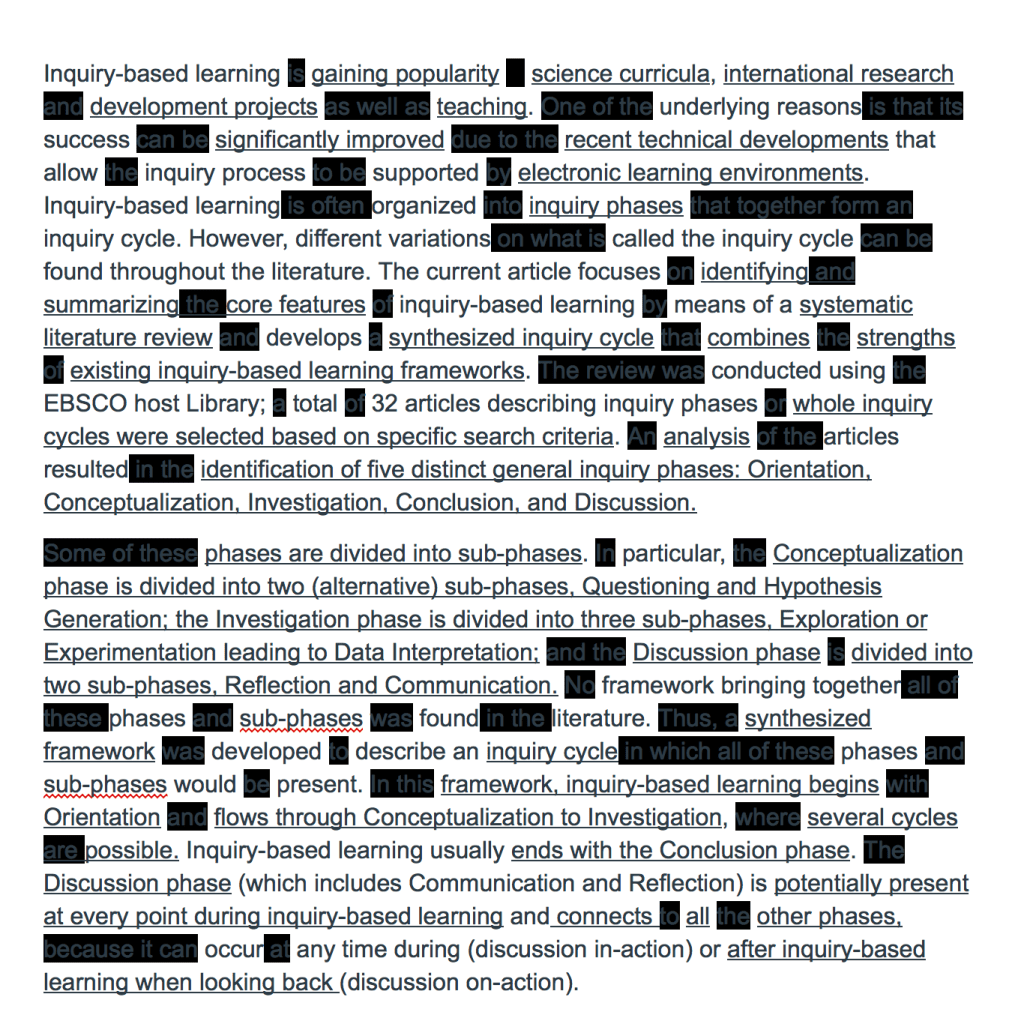
Inquiry-based learning is gaining popularity in science curricula, international research and development projects as well as teaching. One of the underlying reasons is that its success can be significantly improved due to the recent technical developments that allow the inquiry process to be supported by electronic learning environments. Inquiry-based learning is often organized into inquiry phases that together form an inquiry cycle. However, different variations on what is called the inquiry cycle can be found throughout the literature. The current article focuses on identifying and summarizing the core features of inquiry-based learning by means of a systematic literature review and develops a synthesized inquiry cycle that combines the strengths of existing inquiry-based learning frameworks. The review was conducted using the EBSCO host Library; a total of 32 articles describing inquiry phases or whole inquiry cycles were selected based on specific search criteria. An analysis of the articles resulted in the identification of five distinct general inquiry phases: Orientation, Conceptualization, Investigation, Conclusion, and Discussion.

Some of these phases are divided into sub-phases. In particular, the Conceptualization phase is divided into two (alternative) sub-phases, Questioning and Hypothesis Generation; the Investigation phase is divided into three sub-phases, Exploration or Experimentation leading to Data Interpretation; and the Discussion phase is divided into two sub-phases, Reflection and Communication. No framework bringing together all of these phases and sub-phases was found in the literature. Thus, a synthesized framework was developed to describe an inquiry cycle in which all of these phases and sub-phases would be present. In this framework, inquiry-based learning begins with Orientation and flows through Conceptualization to Investigation, where several cycles are possible. Inquiry-based learning usually ends with the Conclusion phase. The Discussion phase (which includes Communication and Reflection) is potentially present at every point during inquiry-based learning and connects to all the other phases, because it can occur at any time during (discussion in-action) or after inquiry-based learning when looking back (discussion on-action).

I read the previous text and followed CHoMP which stands for crossing out small words, highlighting important information, making notes based on the highlights, and putting those notes in my own words. Below you can see steps C and H performed.

Finally, I did steps M and P. Which is taking everything underlined and putting those things into my own words. The notes I gathered through doing this are listed below.
Inquiry-based learning is becoming popular in science, international research, and development projects. These are all based off of electronic learning environments. Inquiry-based learning done in phases forming the inquiry cycle. There are many variations of the cycle, all the strengths of them combine to form 5 phases; Orientation, Conceptualization, Investigation, Conclusion, and Discussion. There are some subphases. Conceptualization has two subphases, question and hypothesis. Investigation has three subphases,exploration or experimentation and data. Discussion has two subphases, reflection and communication.

Main Points

There were three main points of this week. The first was Chapter 5, the second was Chapter 6, and the third was ARCS. Chapter 5 is titled The Means and End of Mental Training: The Psychological and Logical which went over logic and discipline. ARCS was how to inspire students. The main point of this lesson was to understand how to motive learning and to understand this you need to know how the processes of learning takes place.

What Surprised Me!

Minecraft in the classroom…

Honestly, I think this is a great idea. Often times I feel as though teachers are out of touch with their students. I feel as though bringing video games into the classroom would increase productivity. Motivation is key when it comes to a successful learning outcome and having some fun is the best motivation for elementary level education. I was surprised to see how teachers were using Minecraft in the classroom. Having students create a visual representation from a text in Minecraft is a unique ways to make students experience what they are learning. Student-based teaching can be seen through giving students the option to pick how they want to show their knowledge and allowing Minecraft as one of those options is a unique way to get them excited about leaning. Technology in the classroom has always stressed me out and currently going through the transition from student to teacher it has stressed me out even more. However, after reading the article Ideas for Using Minecraft in the Classroom by Andrew Miller my stress turned into excitement about all the new possibilities technology could be used in the classroom.

ARCS

Successfully motivating someone can be done through ACRS; Attention, relevance, confidence, and satisfaction. Attention is all about getting your learners’ interested, relevance is about showing your learners’ what they are doing is useful, confidence is about instilling the idea of wanting success, and satisfaction is about learners’ being content with what they are doing. I’m most comfortable with relevance and least comfortable with satisfaction. Everything done in a classroom has a purpose and as long as you express that purpose I feel as though leaners’ will understand the relevance. When it comes to math referring to toys or candy to 3rd graders but in college making things money based. Or in science using projects that are age appropriate with real world problems that age group may encounter. However, when it comes to satisfaction I hesitate. There is a wide variety of students and each one finds satisfaction in a different way. When it comes to learning I feel that good grades are not enough to have students satisfied because they just memorized a topic once to get the grade then moved on. For real satisfaction I think students need a passion behind each subject and I’m not sure if that is feasible or not.

Design a site like this with WordPress.com
Get started