iPhones have an amazing feature that tells you how many hours you spend on your phone. During quarantine I have gone up almost 50% on my screen time. During my normal week at school I wake up and go to work until I have class. After class it is dinner time, during this time I eat and do my school work. The second I finish work I meet up with my friends. When I’m with my friends or at work I don’t look at technology, it doesn’t even cross my mind. Now that I am home and don’t have time to spend with my friends I have filled that time with my phone. This assignment allowed me to take a break from my new hobby of sitting on my phone. I was a little nervous because of how obsessed with my phone I have been since quarantine it would be hard to fall back into my pattern of not going on it. However, I found it very easy. Whenever I am with friends I don’t check technology and fell right back into that pattern once I reminded myself. Now that I am back online I am grateful because if used correctly it can have so many great assets. When I’m not online I’m normally outside or painting. To get creative inspiration I often use Pinterest.
My First Blog Post
Be yourself; Everyone else is already taken.
— Oscar Wilde.
This is the first post on my new blog. I’m just getting this new blog going, so stay tuned for more. Subscribe below to get notified when I post new updates.
Final Reflection
By biggest struggle with this class was figuring out how to use each application to complete assignments. My computer is very slow making it frustrating trying to complete assignments because it takes so long for my computer to do anything. I learned through this class that it is because of a virus I downloaded. This class gave me a lot of tools to take my assignments to the next level. It also made me more confident in my technology skills. At first I found myself struggling and getting frustrated not knowing how to complete assignments and now I have a lot more tools to use to figure out how to use new media platforms. I remember most the whiteboard assignment. We drew while doing a voice over explaining diffusion of innovation. I remember this because I’ve watched them in class before. I know have made a learning tool from the teacher perspective.
Adobe Spark
Memes


Diffusion Innovation
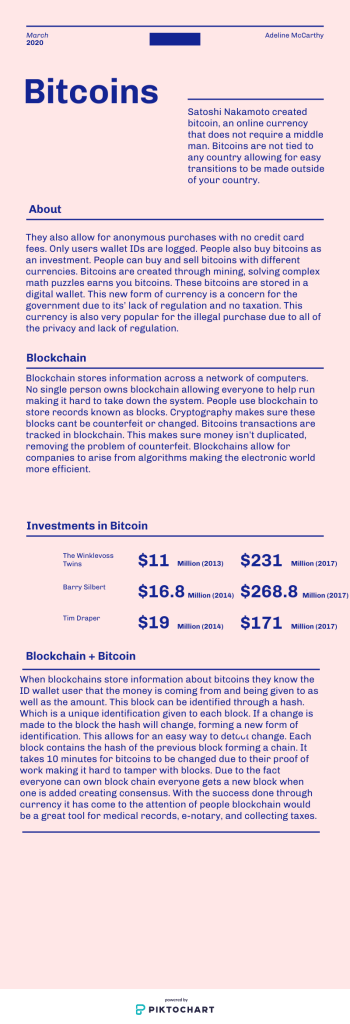
Bitcoins
Week 7 Reflection
This week we took class outside the classroom. I got the chance to work with my group and learn what USF students knew about video games. We asked students what their favorite game was, how often they played, how long is too long to be playing, and if they would let their kid play violent video games. Answered varied, however, the last question, would you let your kids play violent video games got consistent answers. People often reported they would go based off of the age requirement recommended on the game. I love this topic because I wrote my paper on how to bring serious games into the classroom and why. Learning is done through experience which is hard to bring into the classroom, however, I think video games are the perfect solution. Traditional teaching styles are very outdated and I believe the reaching styles we are going to see in the future will be very technology focused. Personally, I would like that technology to bring experience into the classroom through games and simulations which serious games can do.
Cyber Security
This week in class I had a debate with classmates about cybersecurity. We asked ourselves the question should you hack back? What I learned from this is no you shouldn’t hack back and there a couple of reasons why. It is never okay to hack regardless if it was done to you prior. There are security measures that you can take instead, downloading software to protect your computer is a safe way to protect yourself. The police have people in place to track hackers. You also do not know who is hacking you and you don’t want to make matters worse. I didn’t think hacking was a big deal because I didn’t realize that anyone isn’t truly safe. Your money can be taken very easily regardless of your age and so can your identity. There are many motives to hack and everyone is vulnerable. I decided to download software to protect my computer because personally I have been hacked before and didn’t realize how much it could of hurt me. Pop up adds and emails are easy ways to be hacked and I have fallen for them already.
Website Review
Final CHoMP
edaste, M., Mäeots, M., Siiman, L.A., de Jong, T., van Riesen, S.A.N., Kamp, E.T.,Â
Manoli, C.C., Zacharia, Z.C., & Tsourlidaki, E. (2015). Phases of inquiry-basedÂ
learning: Definitions and the inquiry cycle. Educational Research Review, 14,Â
47-61. doi:10.1016/j.edurev.2015.02.003.
Inquiry-based learning is becoming popular in science, international research, and development projects. These are all based off of electronic learning environments. Inquiry-based learning done in phases forming the inquiry cycle. There are many variations of the cycle, all the strengths of them combine to form 5 phases; Orientation, Conceptualization, Investigation, Conclusion, and Discussion. There are some subphases. Conceptualization has two subphases, question and hypothesis. Investigation has three subphases,exploration or experimentation and data. Discussion has two subphases, reflection and communication.
 Adeline's Blog